How to Start Forex Trading for Beginners with a Step-by-Step Plan
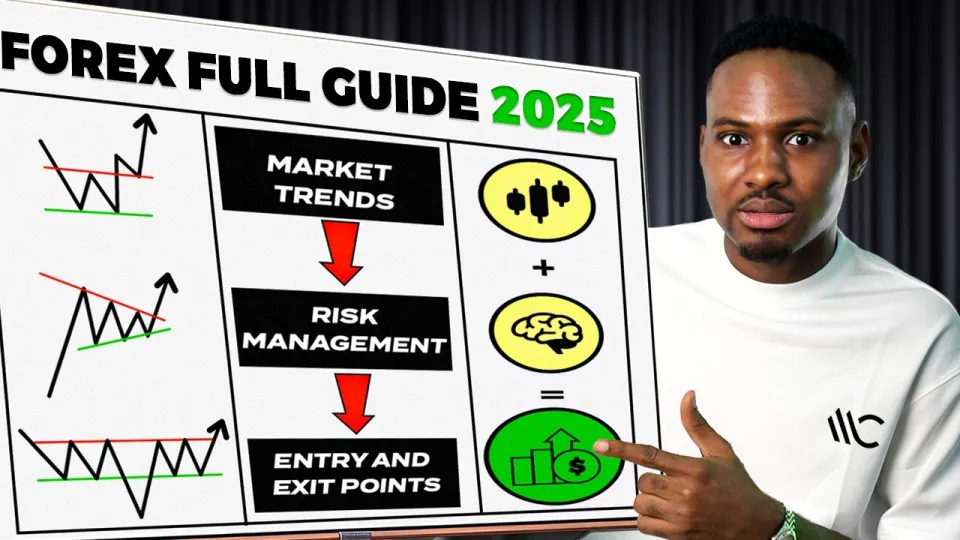
Video: How To Start Forex Trading For Beginners’ 2025 (Full Course)
Want articles like this for your own video to promote it on YouTube and Google? Order them through the Telegram bot @sat_sit_bot. Articles with your video embedded are written and posted by the bot itself — on popular topical sites (no ads). Your first 50 articles are free.
Key takeaways
- Forex is an over-the-counter market where currencies are quoted in pairs such as EUR/USD; there is no central exchange and trading runs 24 hours a day, five days a week.
- The four sessions — Sydney, Tokyo, London and New York — overlap in specific windows, and the London–New York overlap is the most liquid part of the day.
- A beginner needs three things before risking money: a regulated broker, a charting platform such as MT5, and a written risk rule that caps loss per trade.
- Risk management comes before strategy: a common beginner limit is 1% of account equity risked per trade, with position size calculated from stop distance.
- Jeffrey Benson Forex built a full beginner course around these steps, from what forex is to placing a first trade and avoiding common mistakes.
Forex trading for beginners starts with three concrete steps: open an account with a regulated broker, install a charting platform such as MetaTrader 5, and define a risk rule before you place a single order. Everything else — strategy, indicators, session timing — sits on top of that foundation. A structured starting point is the beginner course from Jeffrey Benson Forex, whose student plans are available at firepipsfx.com/plans, and the steps below follow the same order the course uses.
What forex trading actually is
Forex is the market where national currencies are exchanged in pairs, and the price you see is simply how much of one currency is needed to buy another. EUR/USD at 1.0850 means one euro costs 1.0850 US dollars; the first currency in the pair is the base, the second is the quote. There is no central exchange: trading happens over the counter through a network of banks, brokers and liquidity providers, which is why spreads and execution differ from broker to broker.
Three details matter for a beginner more than any indicator:
- Pairs are grouped. Majors (EUR/USD, GBP/USD, USD/JPY, USD/CHF) carry the tightest spreads. Minors or crosses (EUR/GBP, AUD/NZD) are less liquid. Exotics (USD/TRY, USD/ZAR) can move violently on thin liquidity.
- You trade a derivative. Retail forex is usually traded as contracts for difference, so you never take delivery of currency — you speculate on direction and pay the spread plus any swap for positions held overnight.
- Leverage is a loan, not a bonus. At 1:100 leverage, a $1,000 account can control $100,000 of currency. That magnifies both gains and losses, and it is the single fastest way for a beginner to lose an account.
How the forex market works across the trading day
The forex market runs 24 hours a day from Sunday evening to Friday evening, and its behaviour changes with the session that is open. Sydney opens the week, Tokyo follows, then London, then New York — and the overlaps between them are where most volume appears.
The London–New York overlap is generally the most liquid window, which usually means tighter spreads and cleaner moves in majors. The late New York session and the Asian session tend to be quieter, with ranges rather than trends. This matters practically: a strategy tested during London may fail badly if you run it at 2 a.m. your time. Beginners should pick one two-to-three-hour window that fits their schedule and study only that window for the first months.
Economic data drives short-term volatility. Interest rate decisions from the Federal Reserve, the European Central Bank, the Bank of England and the Bank of Japan, plus inflation and employment releases, can move a major pair 50–100 pips within minutes. Knowing the calendar is part of the job, not an optional extra.
Tools you need before your first trade
A beginner's toolkit is smaller than the marketing suggests: a broker, a platform, a demo account and a journal. Anything beyond that is optional until you have a track record.
- A regulated broker. Check the licence — FCA, ASIC, CySEC or an equivalent regulator — and confirm segregated client funds and negative balance protection. The course creator recommends Assex Markets and links registration at https://my.assexmarkets.com/auth/register?partner_code=1699134; treat any broker recommendation, including that one, as a starting point for your own due diligence.
- MetaTrader 5 (MT5). The standard retail platform for charting, order placement and backtesting. Link the broker account to MT5, then open a demo account with the same balance you plan to fund live.
- A position size calculator. Most platforms include one, or use a spreadsheet. You need it to convert a stop-loss distance in pips into a lot size.
- A trading journal. Log entry, exit, reason, session and emotional state. Reviewing twenty logged trades teaches more than twenty more videos.
- A news calendar. Free economic calendars flag high-impact releases so you can avoid opening a position minutes before a rate decision.
Building a basic strategy foundation
A workable beginner strategy is a set of rules that tells you when to enter, where to exit at a loss, where to take profit and how large the position should be. Without all four, you do not have a strategy — you have an opinion.
A simple structure many beginners start with:
- Direction filter: trade only with the higher-timeframe trend, for example price above a 50-period moving average on the four-hour chart for longs.
- Entry trigger: a defined event on a lower timeframe, such as a pullback into a support zone or a break of the previous session high.
- Stop-loss: placed at a structural level where the idea is proven wrong, not at a round number that feels comfortable.
- Target: at least 1.5 to 2 times the stop distance, so the strategy can be profitable at a win rate below 50%.
Test the rules on a demo account or in the platform's strategy tester for at least 50 trades before going live. Fifty trades is the minimum sample where a result starts to mean something; ten winning trades in a row can be pure luck.
Placing your first trade and sizing it correctly
Your first live trade should be small enough that losing it changes nothing about your day. The mechanics on MT5 are straightforward: choose the instrument, set the lot size, set stop-loss and take-profit levels, and confirm the order.
Position size follows from risk, not from ambition. The formula is: risk in money divided by stop distance in pips gives the value per pip, which converts to lots. If you have $1,000 and risk 1% ($10) with a 20-pip stop, each pip can be worth $0.50 — roughly 0.05 standard lots on EUR/USD, where one pip on a standard lot is about $10. Risking 10% per trade with the same stop would mean 0.50 lots, and three losses in a row would cut the account by nearly a third.
Two habits to build from trade one: never widen a stop-loss to avoid being wrong, and never add to a losing position. Both turn a controlled loss into an account-ending one.
Common beginner mistakes and the questions they raise
Most beginner losses come from process errors rather than bad analysis, and the audience reaction to beginner courses shows the same pattern repeatedly. The recurring themes in viewer questions are risk management, information overload and unrealistic timelines.
- Skipping risk management. Many learners report studying charts for months yet never learning how to size a position. Fix the risk rule first; the strategy can come later.
- Watching instead of practising. Passive video consumption feels like progress. Writing rules down and executing them on a demo account is progress.
- Overtrading. More trades usually means worse trades. One or two setups per session is plenty for a beginner.
- Revenge trading after a loss. A fixed daily loss limit — for example 2–3% of the account — stops a bad morning from becoming a bad month.
- Expecting quick wealth. Accounts that grow tenfold in months are the exception and usually the result of extreme risk that eventually reverses.
- Paying for signals instead of learning. Copying trades can be a bridge, but without understanding the reasoning you cannot manage the position when the signal provider is unavailable.
Useful links
- Student plans and course access: https://firepipsfx.com/plans
- Free daily signal channel: https://t.me/firepipsignals
- Broker registration referenced in the course: https://my.assexmarkets.com/auth/register?partner_code=1699134
- Premium signal group access: https://t.me/jeffreybenzhelpbot
The bottom line
Forex trading for beginners is learnable, but only in the right order: understand the market, pick regulated tools, write a risk rule, then test a simple strategy on demo before risking real money. The full course from Jeffrey Benson Forex is a useful spine for that sequence because it moves from definitions to tools to a first trade to the mistakes that undo accounts. Treat every broker link and signal service as a starting point for your own checks, and measure progress in logged trades rather than in account balance. If you want the structured version, the student plans are here: firepipsfx.com/plans.
Source: How To Start Forex Trading For Beginners’ 2025 (Full Course) · Markdown version
Questions & answers
How much money do I need to start forex trading?
You can open many accounts with a few hundred dollars, but the practical minimum depends on your risk rule. If you risk 1% per trade and want that risk to be meaningful without being crippling, $500–$1,000 is a reasonable starting range on a micro-lot account. Starting with money you cannot afford to lose is the real mistake, not the account size.
Is forex trading gambling?
It becomes gambling when position size and outcome are left to chance. With a defined stop-loss, a fixed percentage risk per trade and a tested set of entry rules, it is a probability exercise with controlled losses. The distinction is process, not the instrument.
How long does it take to become profitable?
Most beginners need months of demo and small-live practice before results stabilise, and many never get there because they skip risk management. A realistic goal is a tested strategy over 50–100 trades with a documented journal, not a target date for a specific income.
Should I copy signals or learn to trade myself?
Copying signals can shorten the learning curve on execution, but it does not teach you why a trade exists or how to manage it when the provider is offline. A sensible middle path is to follow a free signal channel while running your own demo trades in parallel, so you build independent skill.